AI Education · AI Education Kit / AI Building Blocks / Hands-on Learning
From ChatGPT to AI building blocks — what matters in the next generation of AI education isn’t that children get better at asking. It’s that they learn to make again.
Take a child from today back a hundred-odd years and stand them in Edison’s laboratory. They would probably find it… backwards.
No large language models.
No cloud computing.
Not even a decent screen.
Just wire, bulbs, metal strips, tools — and experiment after experiment that failed.
And yet almost everything that genuinely changed the world grew out of desks like that one.
So what’s on our children’s desks today?
A tablet, a laptop, a phone — and an increasingly clever chat box.
A child asks:
“Write me an essay.”
The AI writes it.“Draw me a robot.”
The AI draws it.“Design me a smart bin.”
The AI even lists out the whole plan.
Which is genuinely remarkable.
But I keep coming back to one question:
If AI does all the thinking for them, what’s left for the child?
The answer shouldn’t just be:
“Keep asking questions.”
I’d rather it were:
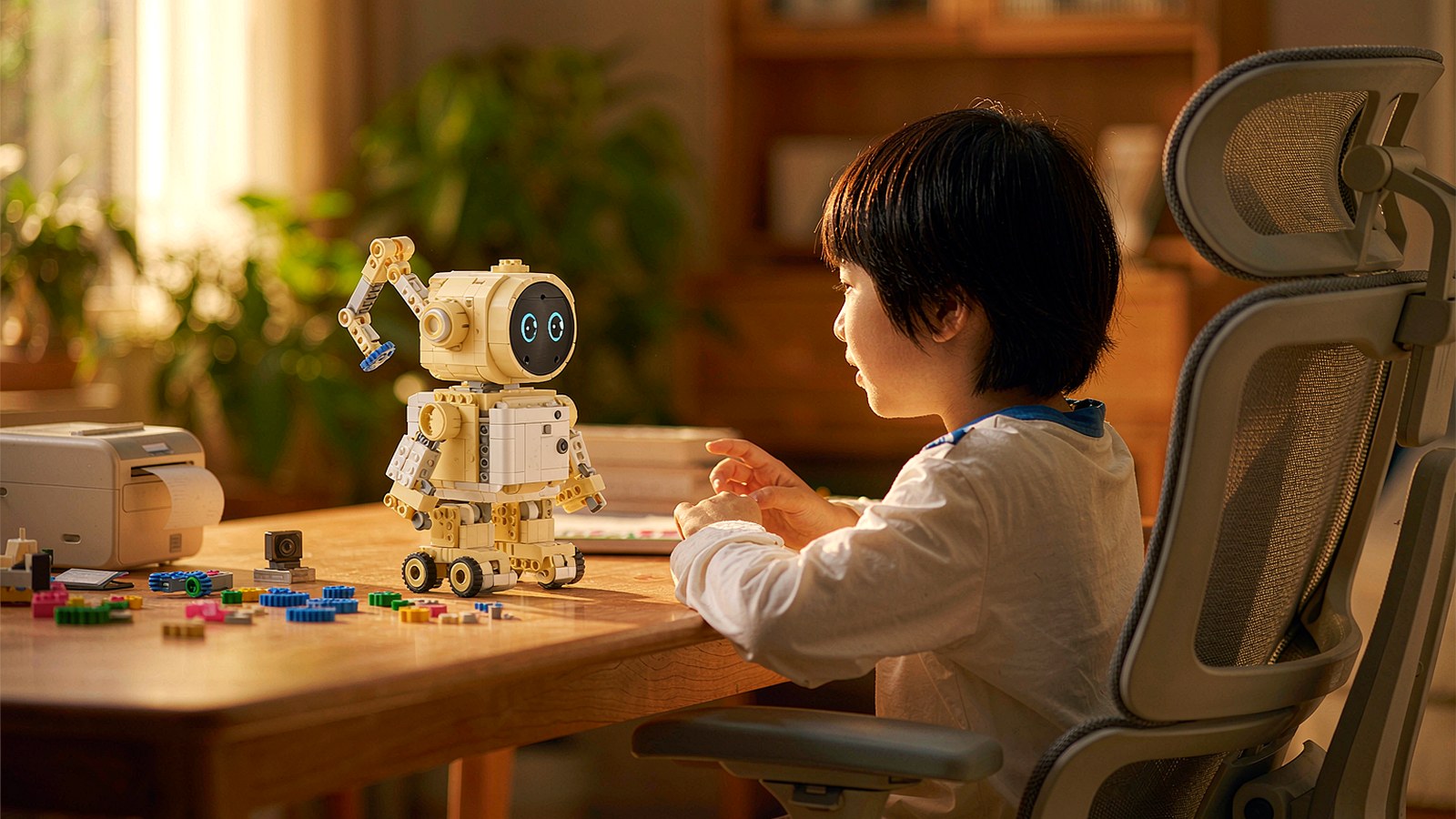
Build the thing with your own hands.
1. AI education can’t stay trapped inside a chat window
For the past two years, most people met AI through ChatGPT.
So naturally we defined “AI education” as:
Learning prompts. Asking questions. Generating essays. Generating images.
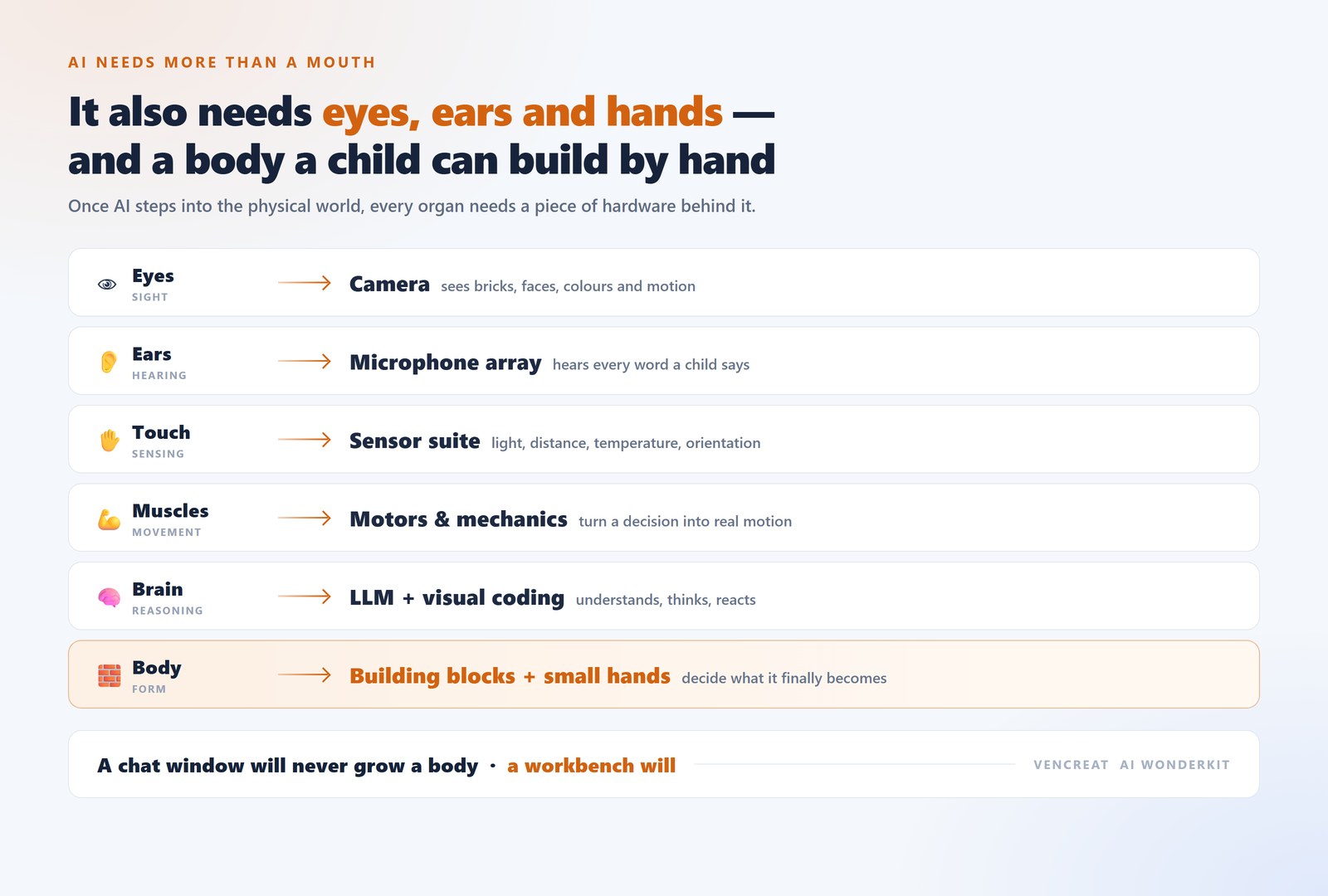
But when AI actually steps into the physical world, it doesn’t have only a mouth.
It should also have:
Eyes.
Ears.
Hands and feet.
And a sense of “feeling” of its own.
A camera is its eyes.
A microphone is its ears.
Sensors are its sense of touch.
Motors are its muscles.
An AI model is its brain.
And the building blocks, the mechanical structure and the child’s own two hands decide what this “creature” finally grows into.
So while building Vencreat AI WonderKit, we held on to one very simple idea:
Don’t just let children use AI.
Let them create an AI of their own.
That’s what we mean by a next-generation AI Education Kit.
2. An eight-year-old and an engineer are doing the same thing
Picture a lesson.
The teacher doesn’t say:
“Today we’re on chapter three of artificial intelligence.”
Instead they throw a problem at the children:
“Can you build an animal that’s afraid of the dark?”
The children start stacking blocks.
One builds a cat.
One builds a dinosaur.
One builds something nobody can quite name.
Then they add a light sensor.
Daylight comes — it sleeps.
Darkness falls — it wakes up.
Then a motor.
Now it wags its tail.
Then a camera.
Now it can “see”.
Then voice input and a generative AI model.
Now it can even answer:
“Why am I afraid of the dark?”
At this point the child has already touched:
Mechanical structure, sensors, conditional logic, Scratch visual programming, motor control, computer vision, voice interaction and generative AI.
But they probably have no idea how “advanced” any of those words are.
They only know one thing:
“I made this.”
A sentence worth far more than “the AI generated it for me.”
3. A line written eight centuries ago still holds in the age of AI
In the Song dynasty, the poet Lu You wrote a line to his son about study:
“What you get from paper is always shallow;
true understanding comes from doing it yourself.”
We’d amend it slightly for our own time:
“What you get from a screen is always shallow;
in the age of AI, you have to build it yourself.”
Knowledge keeps getting cheaper.
Answers keep getting easier to obtain.
What keeps getting more expensive is the ability to turn knowledge into something real.
So the STEAM education, STEM education and AI coding education of the next few years shouldn’t stay as:
“Teacher talks — students listen.”
Nor should it become:
“Student asks — AI answers.”
It should look like:
Ask a question → work with AI → build it → program it → find what broke → fix it → build again
This is also why mature education systems keep emphasising hands-on learning. LEGO Education currently places hands-on learning, coding, AI, problem-solving, creativity and collaboration at the centre of its learning system.[1]
The age of AI has not made hands-on work obsolete.
The opposite.
The smarter AI gets, the more valuable human creativity becomes.
4. WonderKit is not trying to be “another box of bricks”
Ordinary blocks answer:
“What can I build?”
Traditional educational robots mostly answer:
“How do I make it move?”
We wanted AI WonderKit to ask one question further:
“Can the thing I built see, hear, understand — and then react?”
So the whole system is built around six capabilities:
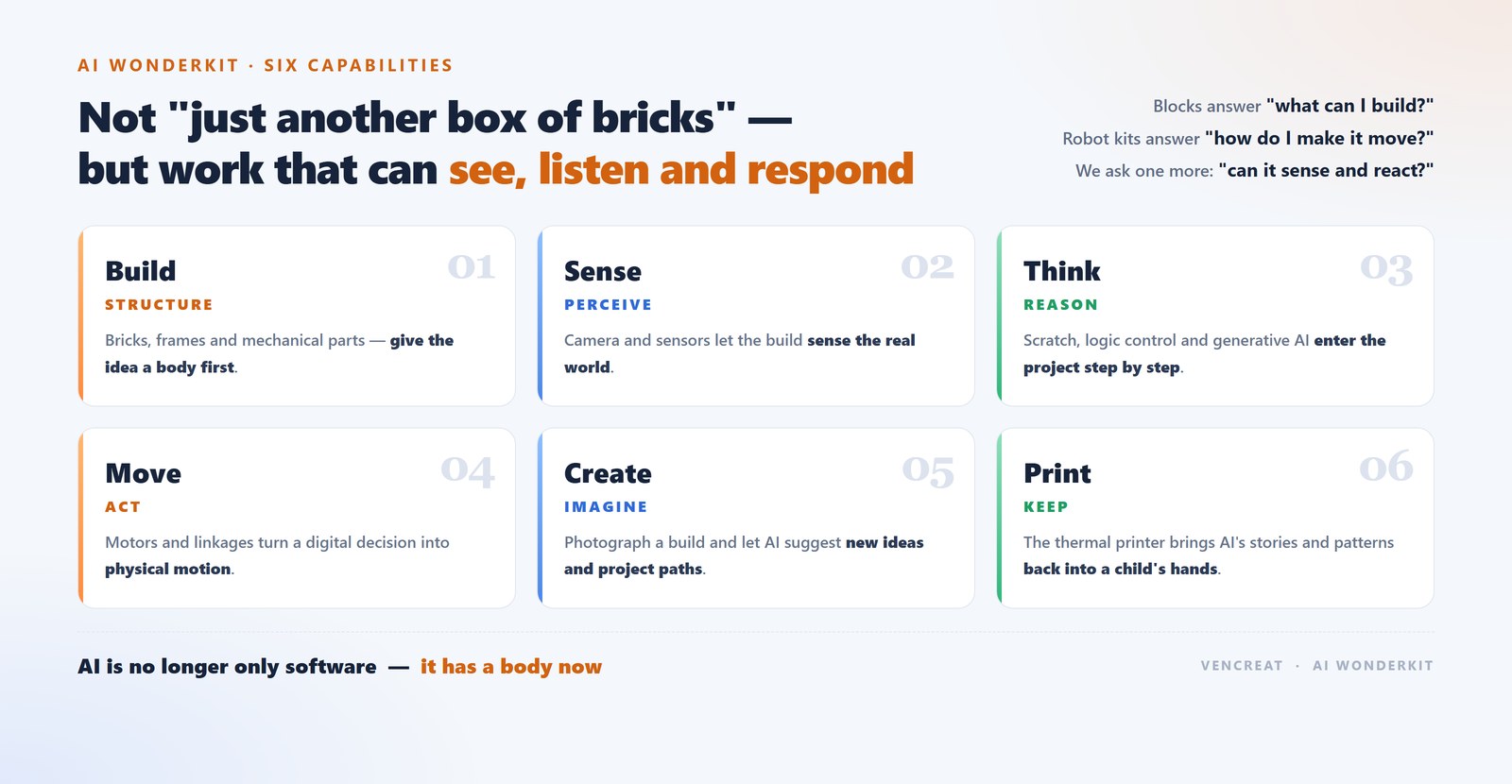
Build — bricks, frames and mechanical parts give an idea a body before anything else.
Sense — cameras and a range of sensors let the build perceive the real world.
Think — Scratch visual programming, logic control and generative AI enter the project step by step.
Move — motors and linkages turn a decision made in software into physical motion.
Create — a child photographs a finished build and AI suggests new structures, project ideas and learning paths.
Print — the thermal printer brings AI-generated stories, tasks, patterns and results off the screen and back into the child’s hands.
And so AI stops being only software.
It has a body now.
5. Real AI education probably isn’t about catching up with AI
After the Industrial Revolution, people feared machines would take their jobs.
When computers arrived, people feared being replaced.
Today we fear AI.
History is funny that way.
The gap that technology finally opens between people is rarely about “who competes better against the machine.”
It’s about:
Who learned earlier to use the new tool to make something that didn’t exist before.
Which is why we don’t want WonderKit to be a “standard-answer machine.”
We want the same box to become:
A robot, for one child.
An AI pet, for another.
A smart door.
A story printer.
And for one more, something no adult can make sense of — but that child is absolutely delighted by.
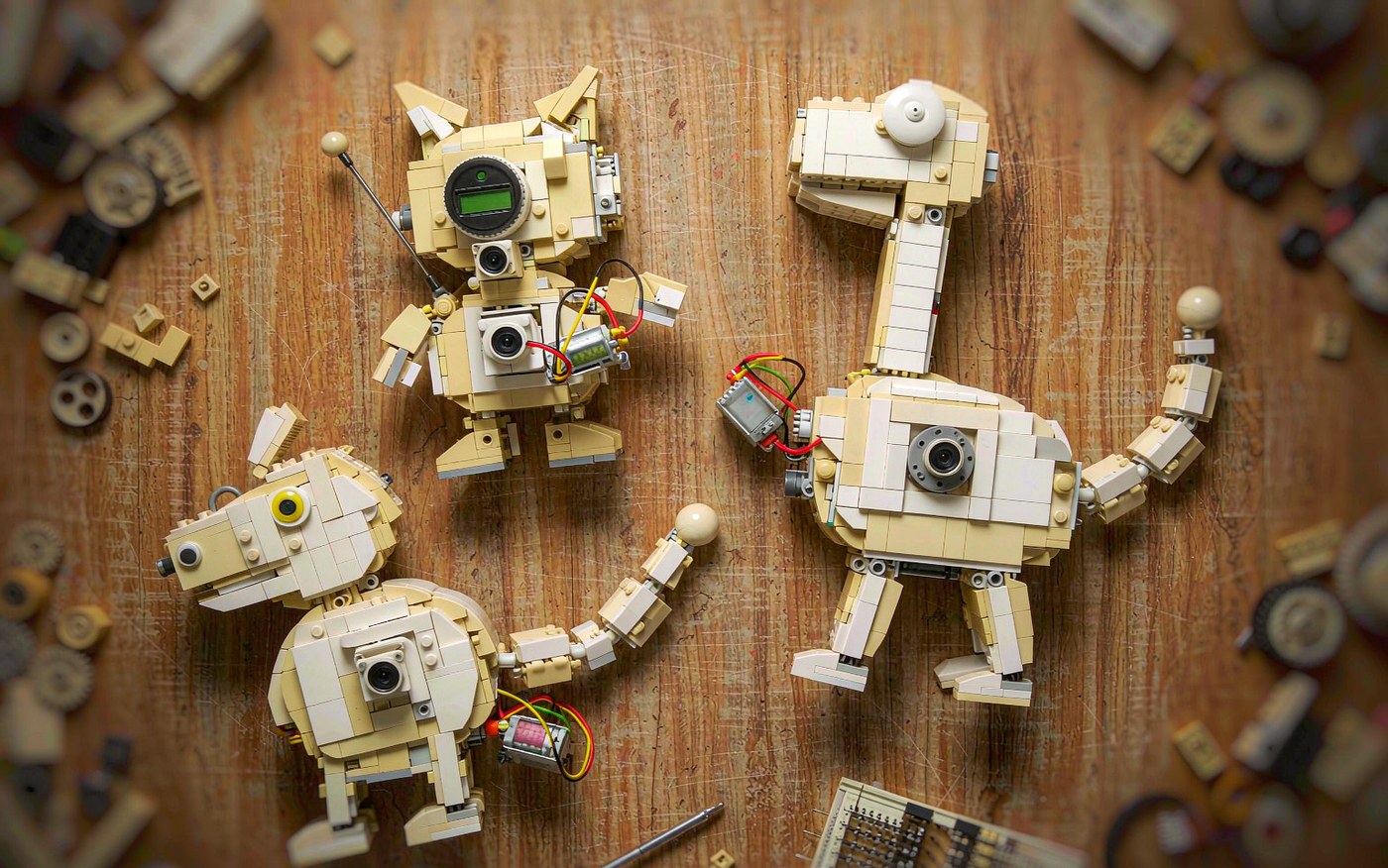
That’s probably the most interesting part of creative education.
6. What should a child actually take away from the age of AI?
Probably not a specific model.
Models will change.
Not a specific chip, either.
Chips will keep upgrading.
Even the software everyone loves today may not exist in ten years.
But a few things don’t go out of date so easily:
Spotting a problem.
Proposing an idea.
Turning an abstract idea into something real.
Starting again after failing.
Finishing a piece of work with other people.
If a child eventually runs over holding a small robot they built themselves and says:
“Look — it actually moves!”
What they gained in that moment is probably more than programming knowledge.
It’s a particular feeling:
I can make things.
That may be the one capability we most want to leave children with in the age of AI.
Read next
→ AI WonderKit product page: six capabilities and configurations
→ More articles in AI Education
About AI WonderKit
Vencreat AI WonderKit is an AI creation kit developed for schools, kids’ coding academies, STEM and STEAM programmes, robotics competitions, makerspaces and home creative learning.
The system combines an AI main unit, building-block structures, sensors, motors, a camera, Scratch visual programming, generative AI and a thermal printer, taking students from simple assembly through to AI, robotics, computer vision, voice and physical-interaction projects.
Keywords:
AI Education Kit / AI Building Blocks / STEM Kit / STEAM Education / Scratch Coding / Educational Robotics / AI Robotics Kit / AI Maker Kit / Hands-on Learning
Best for:
Schools | Kids’ coding academies | STEM competitions | STEAM programmes | Families | Makers
Get in touch:
School partnerships / Sample requests / OEM & ODM / Overseas distribution
vencreat.com/contact · andywei@vencreat.com
Vencreat — Create AI. Build the Real World.