
Over the past year DRAM and NAND contract prices have moved through a significant upcycle. For products where memory and storage make up a meaningful share of the BOM — IPCs, set-top boxes, digital signage — the cost pressure arrives almost immediately. But end markets have not accepted matching price increases. Security and consumer terminals in particular are far more sensitive to price than to specifications.
The squeeze therefore lands on the solution provider: input costs are rising, selling prices are not, and the difference has to come out of the design.
Cost is not only unit price
Looking back at several projects, the real savings rarely came from switching to a cheaper SoC. They came from these places:
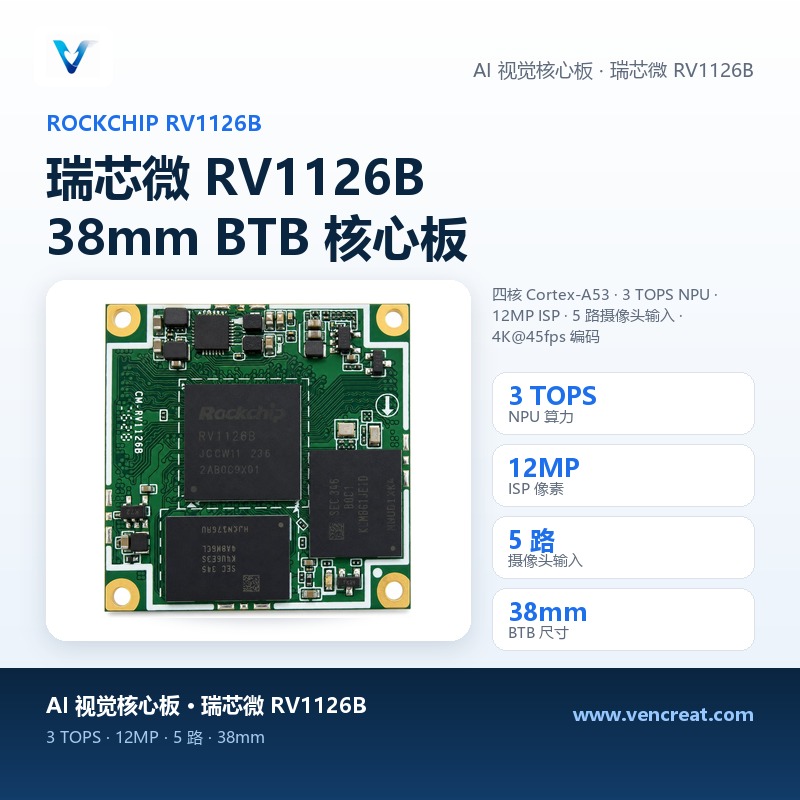
1. Replace several chips with one. Traditional multi-sensor designs often pair a main processor with a stitching chip, or use several low-end SoCs each handling one stream. That multiplies line items, and memory has to be provisioned per chip. A platform like the RV1126B pulls 5 camera inputs, stitching and encoding into a single device — saving not just the processor delta, but memory, PCB area and SMT cost as well.
2. Avoid one more mechanical redesign. The most expensive hidden cost of a platform change is mechanics and certification: new tooling, rerouted traces, repeated compliance testing. Reusing the previous mounting-hole pattern on the camera core, and a standard BTB footprint on the core board, is effectively buying back that time and money.
3. Bring the bitrate down. Storage and bandwidth are recurring costs. H.265 encoding at low bitrate, plus an “analyse on-device first, then transmit” strategy, cuts both what must be stored and what must be sent. For long-retention deployments this is a continuous operating saving.
4. Do not pay for compute you will never use. 3 TOPS covers most on-device vision models. But a product that only displays and plays back does not need an NPU, and that money is pure cost. Conversely, if models have to be offloaded to the cloud, the money saved on silicon comes back as data plans and server bills.
Three practical rules for an upcycle
Make memory a configuration, not a fixed spec. 1GB versus 2GB, 8GB versus 32GB serve very different customers: tier-one customers will pay for headroom, cost-driven customers want the price held. Define the ladder at product-definition time rather than cutting features later.
Evaluate supply certainty as a specification. The real risk in an upcycle is not price, it is allocation. Core boards held in stock, long-term BSP maintenance, and multiple delivery formats from one platform (core board, camera core, finished device) never appear on a quotation — but they decide whether a project ships on time.
Let one platform cover a product family. A camera line may include single-lens, dual-lens, 4G and PoE variants. Changing platform for each one multiplies R&D and material-management cost. One core board with different carriers and companion boards is more resilient.
One caution
Cost reduction is not specification reduction. Once low-light imaging, wide dynamic range or on-device model accuracy degrades, the cost of rework in the field far exceeds the parts saving. Durable cost reduction comes from architectural simplification and reuse, not from downgrading critical components to “good enough”.
Vencreat supports evaluation on two platforms: RV1126B (3 TOPS AI vision) and H618 (HD display). Datasheets are available in English and Chinese, with small-batch sampling. For selection questions, contact sales@vencreat.com.